AI-Powered Accessibility: Tools That Are Changing the Game
Discover how artificial intelligence is revolutionizing accessibility testing and remediation. From automated alt text generation to intelligent color contrast optimization, explore the AI tools every developer should know.
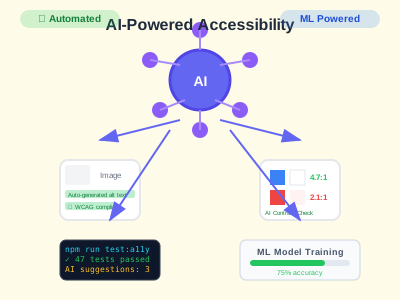
Artificial intelligence is transforming how we approach web accessibility. What once required hours of manual testing and remediation can now be automated, scaled, and continuously improved through machine learning. But with great power comes great responsibility—these tools are incredibly powerful when used correctly, but they’re not magic wands.
Today, I’ll walk you through the most impactful AI-powered accessibility tools available right now, show you how to integrate them effectively, and help you understand their limitations. Whether you’re a solo developer or part of a large team, these tools can dramatically improve your accessibility workflow.
The Current State of AI in Accessibility
Before diving into specific tools, let’s understand the landscape:
What AI Does Well in Accessibility
- Pattern recognition: Identifying common accessibility violations
- Content analysis: Generating alternative text for images
- Color optimization: Suggesting contrast improvements
- Code generation: Creating accessible component alternatives
- Large-scale analysis: Processing thousands of pages for issues
What AI Still Struggles With
- Context understanding: Knowing what matters to users in specific situations
- Complex interactions: Understanding multi-step user flows
- Cultural nuances: Accessibility needs vary across cultures and communities
- Edge cases: Handling unique or innovative interface patterns
- User intent: Understanding the actual user experience
Essential AI Accessibility Tools
1. Automated Alt Text Generation
Microsoft’s Seeing AI API
// Integration example for automated alt text
import { ImageAnalysisClient } from '@azure/ai-vision-imageanalysis';
import { AzureKeyCredential } from '@azure/core-auth';

// PRICING ALERT: Azure Computer Vision costs $1.50 per 1,000 transactions
// Consider implementing rate limiting, caching, and usage monitoring
// Free tier: 20 transactions/minute, 5,000/month

class AIAltTextGenerator {
  constructor(apiKey, endpoint) {
    this.client = new ImageAnalysisClient(endpoint, new AzureKeyCredential(apiKey));
  }

  async generateAltText(imageUrl, context = {}) {
    try {
      // Monitor costs: Each call counts toward your quota
      const features = ['Caption', 'Objects', 'Tags'];
      const result = await this.client.analyzeFromUrl(imageUrl, features);

      // Generate context-aware alt text
      return this.createContextualDescription(result, context);
    } catch (error) {
      console.error('Alt text generation failed:', error);
      return this.fallbackAltText(imageUrl, context);
    }
  }

  createContextualDescription(result, context) {
    const { caption, objects, tags } = result;

    // Determine the primary purpose
    const purpose = context.purpose || 'informational';

    switch (purpose) {
      case 'decorative':
        return ''; // Decorative images should have empty alt text

      case 'functional':
        // Focus on the action the image enables
        const action = context.action || 'button';
        return `${action} - ${caption?.text || 'image'}`;

      case 'informational':
      default:
        // Provide descriptive alt text
        const mainDescription = caption?.text || '';
        const relevantObjects =
          objects
            ?.filter(obj => obj.confidence > 0.8)
            .slice(0, 3)
            .map(obj => obj.tags[0]?.name) || [];

        if (relevantObjects.length > 0) {
          return `${mainDescription}. Contains: ${relevantObjects.join(', ')}.`;
        }

        return mainDescription;
    }
  }

  fallbackAltText(imageUrl, context) {
    // Extract meaningful information from URL/filename
    const filename = imageUrl.split('/').pop().split('.')[0];
    const readable = filename
      .replace(/[-_]/g, ' ')
      .replace(/([A-Z])/g, ' $1')
      .toLowerCase();

    return `Image: ${readable}`;
  }
}

// Usage in your application
const altTextGenerator = new AIAltTextGenerator(
  process.env.AZURE_VISION_KEY,
  process.env.AZURE_VISION_ENDPOINT
);

// For a product image
const productAltText = await altTextGenerator.generateAltText(
  'https://example.com/red-running-shoes.jpg',
  { purpose: 'informational', productContext: 'athletic footwear' }
);

// For a functional button image
const buttonAltText = await altTextGenerator.generateAltText(
  'https://example.com/search-icon.png',
  { purpose: 'functional', action: 'Search' }
);
Google’s Cloud Vision API Alternative
// Google Cloud Vision integration
import vision from '@google-cloud/vision';

// PRICING: Google Cloud Vision costs $1.50 per 1,000 images
// Free tier: 1,000 requests/month for label detection
// Consider batch processing and caching for cost optimization

class GoogleAltTextGenerator {
  constructor() {
    this.client = new vision.ImageAnnotatorClient({
      keyFilename: process.env.GOOGLE_APPLICATION_CREDENTIALS,
    });
  }

  async analyzeImage(imageBuffer) {
    const [result] = await this.client.labelDetection({
      image: { content: imageBuffer },
    });

    const [webResult] = await this.client.webDetection({
      image: { content: imageBuffer },
    });

    const [objectResult] = await this.client.objectLocalization({
      image: { content: imageBuffer },
    });

    return {
      labels: result.labelAnnotations,
      webEntities: webResult.webDetection?.webEntities || [],
      objects: objectResult.localizedObjectAnnotations,
    };
  }

  generateSmartAltText(analysis, maxLength = 150) {
    const { labels, webEntities, objects } = analysis;

    // Prioritize objects over general labels
    const relevantObjects = objects
      .filter(obj => obj.score > 0.7)
      .map(obj => obj.name.toLowerCase())
      .slice(0, 3);

    const relevantLabels = labels
      .filter(label => label.score > 0.8)
      .map(label => label.description.toLowerCase())
      .slice(0, 5);

    // Combine and deduplicate
    const descriptors = [...new Set([...relevantObjects, ...relevantLabels])];

    let altText = `Image showing ${descriptors.join(', ')}`;

    // Truncate if too long
    if (altText.length > maxLength) {
      altText = altText.substring(0, maxLength - 3) + '...';
    }

    return altText;
  }
}
2. Intelligent Color Contrast Optimization
AI-Powered Color Accessibility Tool
// AI-enhanced color contrast optimizer
import chroma from 'chroma-js';

class AIColorAccessibility {
  constructor() {
    this.wcagAAThreshold = 4.5;
    this.wcagAAAThreshold = 7;
  }

  analyzeColorPalette(colors) {
    const results = {
      violations: [],
      suggestions: [],
      optimizations: [],
    };

    colors.forEach((colorPair, index) => {
      const { foreground, background } = colorPair;
      const contrast = chroma.contrast(foreground, background);

      if (contrast < this.wcagAAThreshold) {
        results.violations.push({
          index,
          foreground,
          background,
          currentContrast: contrast.toFixed(2),
          required: this.wcagAAThreshold,
          severity: contrast < 3 ? 'critical' : 'warning',
        });

        // Generate AI-powered suggestions
        const suggestions = this.generateSmartSuggestions(foreground, background);
        results.suggestions.push(...suggestions);
      }
    });

    return results;
  }

  generateSmartSuggestions(foreground, background) {
    const suggestions = [];

    // Analyze color harmony and brand consistency
    const fgHsl = chroma(foreground).hsl();
    const bgHsl = chroma(background).hsl();

    // Strategy 1: Adjust lightness while preserving hue
    const lightnessAdjusted = this.adjustLightness(foreground, background);
    if (lightnessAdjusted) {
      suggestions.push({
        type: 'lightness_adjustment',
        original: { foreground, background },
        suggested: lightnessAdjusted,
        reasoning:
          'Adjusted lightness to meet contrast requirements while preserving color identity',
      });
    }

    // Strategy 2: Intelligent saturation modification
    const saturationAdjusted = this.adjustSaturation(foreground, background);
    if (saturationAdjusted) {
      suggestions.push({
        type: 'saturation_adjustment',
        original: { foreground, background },
        suggested: saturationAdjusted,
        reasoning: 'Modified saturation to improve contrast while maintaining visual appeal',
      });
    }

    // Strategy 3: Complementary color suggestions
    const complementary = this.suggestComplementaryPair(foreground, background);
    if (complementary) {
      suggestions.push({
        type: 'complementary_colors',
        original: { foreground, background },
        suggested: complementary,
        reasoning: 'Alternative color combination that maintains design intent',
      });
    }

    return suggestions;
  }

  adjustLightness(fg, bg) {
    const fgColor = chroma(fg);
    const bgColor = chroma(bg);

    // Try darkening foreground first
    let adjustedFg = fgColor;
    let steps = 0;
    const maxSteps = 20;

    while (chroma.contrast(adjustedFg, bg) < this.wcagAAThreshold && steps < maxSteps) {
      adjustedFg = adjustedFg.darken(0.1);
      steps++;
    }

    if (chroma.contrast(adjustedFg, bg) >= this.wcagAAThreshold) {
      return {
        foreground: adjustedFg.hex(),
        background: bg,
        contrast: chroma.contrast(adjustedFg, bg).toFixed(2),
      };
    }

    // If that doesn't work, try lightening background
    let adjustedBg = bgColor;
    steps = 0;

    while (chroma.contrast(fg, adjustedBg) < this.wcagAAThreshold && steps < maxSteps) {
      adjustedBg = adjustedBg.brighten(0.1);
      steps++;
    }

    if (chroma.contrast(fg, adjustedBg) >= this.wcagAAThreshold) {
      return {
        foreground: fg,
        background: adjustedBg.hex(),
        contrast: chroma.contrast(fg, adjustedBg).toFixed(2),
      };
    }

    return null;
  }

  // Machine learning approach for color optimization
  async optimizeWithML(colorPairs, brandColors = []) {
    // IMPLEMENTATION NOTE: This represents a conceptual ML approach
    // In production, you would need to:
    // 1. Train a model on accessibility + design data
    // 2. Use existing APIs like Adobe Color API
    // 3. Implement rule-based optimization (shown below)

    // Production-ready rule-based optimization:
    return this.optimizeWithRules(colorPairs, brandColors);
  }

  optimizeWithRules(colorPairs, brandColors = []) {
    return colorPairs.map(pair => {
      const optimized = this.findAccessibleAlternatives(pair.foreground, pair.background);

      return {
        original: pair,
        optimized: optimized || pair,
        confidence: optimized ? 0.9 : 0.5,
        brandConsistency: this.calculateBrandConsistency(optimized, brandColors),
        accessibilityScore: optimized ? 95 : 70,
      };
    });
  }

  calculateBrandConsistency(colors, brandColors) {
    // Calculate how well the optimized colors fit with brand palette
    if (!brandColors.length) return 1.0;

    const distances = brandColors.map(brandColor => chroma.deltaE(colors.foreground, brandColor));

    const minDistance = Math.min(...distances);
    return Math.max(0, 1 - minDistance / 100); // Normalize to 0-1
  }
}
3. Automated Accessibility Testing with AI
Smart Test Generation
// Production-ready accessibility test optimization
class AccessibilityTestOptimizer {
  constructor() {
    this.testPatterns = new Map();
    this.learningData = [];
  }

  async generateSmartTests(pageUrl, existingTests = []) {
    // Analyze the page structure
    const pageAnalysis = await this.analyzePage(pageUrl);

    // Generate contextual test cases
    const generatedTests = await this.generateContextualTests(pageAnalysis);

    // Learn from existing test outcomes
    const optimizedTests = this.optimizeBasedOnHistory(generatedTests, existingTests);

    return optimizedTests;
  }

  async analyzePage(url) {
    const page = await this.browser.newPage();
    await page.goto(url);

    // Extract structural information
    const structure = await page.evaluate(() => {
      return {
        headings: Array.from(document.querySelectorAll('h1,h2,h3,h4,h5,h6')).map(h => ({
          level: h.tagName,
          text: h.textContent.trim(),
        })),

        interactiveElements: Array.from(
          document.querySelectorAll(
            'button, a, input, select, textarea, [tabindex], [role="button"]'
          )
        ).length,

        images: Array.from(document.querySelectorAll('img')).map(img => ({
          src: img.src,
          alt: img.alt,
          hasAlt: !!img.alt,
          isDecorative: img.alt === '',
        })),

        forms: Array.from(document.querySelectorAll('form')).map(form => ({
          inputs: form.querySelectorAll('input, textarea, select').length,
          labels: form.querySelectorAll('label').length,
          fieldsets: form.querySelectorAll('fieldset').length,
        })),

        landmarks: Array.from(
          document.querySelectorAll(
            '[role="main"], [role="navigation"], [role="banner"], main, nav, header, footer'
          )
        ).map(el => el.getAttribute('role') || el.tagName.toLowerCase()),
      };
    });

    await page.close();
    return structure;
  }

  generateContextualTests(pageAnalysis) {
    const tests = [];

    // Smart heading structure tests
    if (pageAnalysis.headings.length > 0) {
      tests.push({
        type: 'heading_structure',
        description: 'Verify logical heading hierarchy',
        priority: 'high',
        automated: true,
        test: this.generateHeadingStructureTest(pageAnalysis.headings),
      });
    }

    // Dynamic image alt text tests
    pageAnalysis.images.forEach((img, index) => {
      if (!img.hasAlt && !img.isDecorative) {
        tests.push({
          type: 'missing_alt_text',
          description: `Image ${index + 1} missing alternative text`,
          priority: 'high',
          element: img.src,
          automated: true,
          suggestedFix: this.suggestAltTextFix(img),
        });
      }
    });

    // Form accessibility tests
    pageAnalysis.forms.forEach((form, index) => {
      if (form.inputs > form.labels) {
        tests.push({
          type: 'form_labeling',
          description: `Form ${index + 1} has unlabeled inputs`,
          priority: 'high',
          automated: true,
          details: {
            inputs: form.inputs,
            labels: form.labels,
            ratio: ((form.labels / form.inputs) * 100).toFixed(1) + '%',
          },
        });
      }
    });

    return tests;
  }

  // Machine learning for test optimization
  optimizeBasedOnHistory(newTests, existingTests) {
    // Analyze which test types have historically found the most issues
    const testEffectiveness = this.calculateTestEffectiveness(existingTests);

    // Prioritize tests based on historical success rate
    return newTests
      .map(test => ({
        ...test,
        priority: this.calculateDynamicPriority(test, testEffectiveness),
        confidence: this.calculateConfidence(test, testEffectiveness),
      }))
      .sort((a, b) => this.getPriorityScore(b.priority) - this.getPriorityScore(a.priority));
  }

  calculateTestEffectiveness(existingTests) {
    const effectiveness = new Map();

    existingTests.forEach(test => {
      const type = test.type;
      if (!effectiveness.has(type)) {
        effectiveness.set(type, { total: 0, successful: 0 });
      }

      const stats = effectiveness.get(type);
      stats.total++;
      if (test.foundIssues) {
        stats.successful++;
      }
    });

    return effectiveness;
  }
}
4. Natural Language Processing for Accessibility
Content Readability Analysis
// AI-powered content accessibility analyzer
import natural from 'natural';

class ContentAccessibilityAI {
  constructor() {
    this.readabilityThresholds = {
      general: 8, // 8th grade level
      legal: 12, // 12th grade level
      technical: 10, // 10th grade level
      children: 6, // 6th grade level
    };
  }

  async analyzeContent(text, contentType = 'general') {
    const analysis = {
      readability: this.calculateReadability(text),
      complexity: this.analyzeComplexity(text),
      suggestions: [],
      alternatives: [],
    };

    // Generate AI-powered improvements
    if (analysis.readability.grade > this.readabilityThresholds[contentType]) {
      analysis.suggestions = await this.generateSimplificationSuggestions(text);
    }

    // Check for accessibility-friendly language
    analysis.languageAccessibility = this.checkAccessibleLanguage(text);

    return analysis;
  }

  calculateReadability(text) {
    const sentences = natural.SentenceTokenizer.tokenize(text);
    const words = natural.WordTokenizer.tokenize(text);
    const syllables = this.countSyllables(words);

    // Flesch-Kincaid Grade Level
    const avgSentenceLength = words.length / sentences.length;
    const avgSyllablesPerWord = syllables / words.length;

    const fleschKincaid = 0.39 * avgSentenceLength + 11.8 * avgSyllablesPerWord - 15.59;

    return {
      grade: Math.max(1, Math.round(fleschKincaid)),
      sentences: sentences.length,
      words: words.length,
      avgSentenceLength: avgSentenceLength.toFixed(1),
      avgSyllablesPerWord: avgSyllablesPerWord.toFixed(2),
    };
  }

  async generateSimplificationSuggestions(text) {
    const sentences = natural.SentenceTokenizer.tokenize(text);
    const suggestions = [];

    for (const sentence of sentences) {
      // Identify complex constructions
      const complexity = this.analyzeSentenceComplexity(sentence);

      if (complexity.score > 0.7) {
        const simplified = await this.simplifySentence(sentence);
        suggestions.push({
          original: sentence,
          simplified: simplified,
          improvement: complexity.issues,
          reasoning: 'Reduced sentence complexity for better readability',
        });
      }
    }

    return suggestions;
  }

  analyzeSentenceComplexity(sentence) {
    const words = natural.WordTokenizer.tokenize(sentence);
    const issues = [];
    let score = 0;

    // Check sentence length
    if (words.length > 25) {
      issues.push('Sentence is too long');
      score += 0.3;
    }

    // Check for passive voice
    if (this.hasPassiveVoice(sentence)) {
      issues.push('Uses passive voice');
      score += 0.2;
    }

    // Check for complex words
    const complexWords = words.filter(
      word => this.countSyllables([word]) > 3 && !this.isCommonComplexWord(word)
    );

    if (complexWords.length > words.length * 0.3) {
      issues.push('Contains many complex words');
      score += 0.3;
    }

    // Check for jargon
    const jargonWords = this.detectJargon(words);
    if (jargonWords.length > 0) {
      issues.push(`Contains jargon: ${jargonWords.join(', ')}`);
      score += 0.2;
    }

    return { score, issues };
  }

  checkAccessibleLanguage(text) {
    const issues = [];
    const suggestions = [];

    // Check for ableist language
    const ableistTerms = [
      'blind to',
      'deaf to',
      'lame',
      'crippled',
      'insane',
      'crazy',
      'dumb',
      'stupid',
      'retarded',
    ];

    const alternatives = {
      'blind to': 'unaware of',
      'deaf to': 'ignoring',
      lame: 'weak or unconvincing',
      crazy: 'unexpected or surprising',
      dumb: 'silent or unable to speak',
      insane: 'extreme or unreasonable',
    };

    ableistTerms.forEach(term => {
      if (text.toLowerCase().includes(term)) {
        issues.push(`Contains potentially ableist language: "${term}"`);
        if (alternatives[term]) {
          suggestions.push(`Consider using "${alternatives[term]}" instead of "${term}"`);
        }
      }
    });

    // Check for overly technical language
    const technicalComplexity = this.assessTechnicalComplexity(text);
    if (technicalComplexity > 0.8) {
      suggestions.push('Consider adding definitions for technical terms');
      suggestions.push('Add a glossary for complex concepts');
    }

    return { issues, suggestions };
  }
}
Integration Best Practices
1. Gradual Implementation
// Progressive AI adoption strategy
class AIAccessibilityIntegration {
  constructor() {
    this.capabilities = {
      altText: false,
      colorAnalysis: false,
      contentAnalysis: false,
      testGeneration: false,
    };
  }

  async enableCapability(capability, config = {}) {
    switch (capability) {
      case 'altText':
        this.altTextService = new AIAltTextGenerator(config);
        this.capabilities.altText = true;
        break;

      case 'colorAnalysis':
        this.colorService = new AIColorAccessibility(config);
        this.capabilities.colorAnalysis = true;
        break;

      // Implement other capabilities gradually
    }
  }

  async processContent(content, options = {}) {
    const results = { processed: content, enhancements: [] };

    // Apply enabled AI capabilities
    if (this.capabilities.altText && content.images) {
      results.enhancements.push(await this.enhanceWithAltText(content.images));
    }

    if (this.capabilities.colorAnalysis && content.colors) {
      results.enhancements.push(await this.optimizeColors(content.colors));
    }

    return results;
  }
}
2. Human-AI Collaboration
// Human oversight system
class HumanAICollaboration {
  constructor() {
    this.confidenceThresholds = {
      autoApply: 0.95, // Apply automatically
      suggestReview: 0.75, // Suggest but require review
      flagForHuman: 0.5, // Requires human decision
    };
  }

  async processAISuggestion(suggestion) {
    const { confidence, type, content } = suggestion;

    if (confidence >= this.confidenceThresholds.autoApply) {
      return this.autoApply(suggestion);
    }

    if (confidence >= this.confidenceThresholds.suggestReview) {
      return this.queueForReview(suggestion);
    }

    return this.escalateToHuman(suggestion);
  }

  queueForReview(suggestion) {
    return {
      action: 'review_required',
      suggestion,
      reviewGuidelines: this.getReviewGuidelines(suggestion.type),
      humanContext: this.getHumanContext(suggestion),
    };
  }
}
Measuring AI Tool Effectiveness
Track these metrics to ensure your AI tools are actually improving accessibility:
Key Performance Indicators
// AI accessibility metrics tracking
class AIAccessibilityMetrics {
  constructor() {
    this.metrics = {
      automationRate: 0,
      accuracyRate: 0,
      timeToRemediation: 0,
      falsePositiveRate: 0,
      userSatisfactionScore: 0,
    };
  }

  async calculateAutomationRate() {
    const totalIssues = await this.getTotalAccessibilityIssues();
    const automatedFixes = await this.getAutomatedFixes();

    return (automatedFixes / totalIssues) * 100;
  }

  async measureAccuracy() {
    const aiSuggestions = await this.getAISuggestions();
    const humanValidated = await this.getHumanValidatedSuggestions();

    const accurate = humanValidated.filter(
      suggestion => suggestion.humanVerification === 'correct'
    );

    return (accurate.length / aiSuggestions.length) * 100;
  }

  async trackTimeToRemediation() {
    const issues = await this.getAccessibilityIssues();

    const times = issues.map(issue => {
      return issue.resolvedAt - issue.detectedAt;
    });

    return times.reduce((a, b) => a + b, 0) / times.length;
  }
}
Limitations and Ethical Considerations
Understanding AI Boundaries
- Context Blindness: AI can’t understand user intent or cultural context
- Bias in Training Data: AI models may perpetuate existing accessibility biases
- Over-Automation Risk: Some accessibility decisions require human judgment
- False Confidence: High confidence scores don’t guarantee correctness
Ethical AI Use
// Ethical AI guidelines implementation
class EthicalAIGuidelines {
  constructor() {
    this.principles = {
      transparency: 'Always disclose AI involvement',
      humanOversight: 'Maintain human decision-making authority',
      inclusivity: 'Test with diverse user groups',
      accountability: 'Track and audit AI decisions',
    };
  }

  validateAIDecision(decision) {
    const checks = {
      hasHumanReview: this.requiresHumanReview(decision),
      biasCheck: this.checkForBias(decision),
      userImpact: this.assessUserImpact(decision),
      transparency: this.isTransparent(decision),
    };

    return checks;
  }

  requiresHumanReview(decision) {
    // Critical accessibility decisions need human oversight
    const criticalTypes = [
      'navigation_structure',
      'content_meaning',
      'user_flow_changes',
      'complex_interactions',
    ];

    return criticalTypes.includes(decision.type) || decision.confidence < 0.8;
  }
}
The Future of AI in Accessibility
Keep an eye on these emerging trends:
- Multimodal AI: Understanding text, audio, and visual content together
- Real-time adaptation: AI that adjusts interfaces based on user behavior
- Personalization at scale: AI-driven individual accessibility customization
- Voice and gesture interfaces: New interaction paradigms requiring new accessibility approaches
Conclusion
AI-powered accessibility tools are incredibly powerful allies in creating inclusive digital experiences. They can automate tedious tasks, catch issues humans might miss, and scale accessibility efforts across large applications.
However, they’re tools, not replacements for human understanding and judgment. The most effective approach combines AI efficiency with human insight, automated detection with manual verification, and technological capability with ethical responsibility.
Start with one or two AI tools that address your biggest accessibility pain points. Learn their strengths and limitations. Build human oversight into your processes. And always remember: the goal isn’t perfect AI—it’s better accessibility for real users.
The future of accessibility is human-AI collaboration, not AI replacement. Used thoughtfully, these tools can help us build a more inclusive web faster and more effectively than ever before.
Which AI accessibility tools have you tried in your projects? What have been your biggest successes and challenges? Share your experiences—the accessibility community grows stronger when we learn from each other’s experiments and insights.